Stability is not boring when your workflows depend on it
One of the most significant steps in 2025 was callas becoming part of the Durst ecosystem. For our users and OEM partners, the important part is not the transaction itself, but what it enables.
callas continues to operate independently. Existing OEM contracts remain unchanged. The product roadmap stays focused on real production requirements — but is now backed by the long-term stability and resources of a larger industrial group.
For anyone running automation workflows that are expected to work reliably for years, this matters. It reduces risk. It increases planning certainty. And it ensures that the tools you build into your production systems today will still be supported tomorrow.
Making powerful software more accessible — without dumbing it down
pdfToolbox has always been designed for real production PDFs, not idealized files. That power comes with complexity — and in 2025, we invested heavily in making that complexity more approachable.
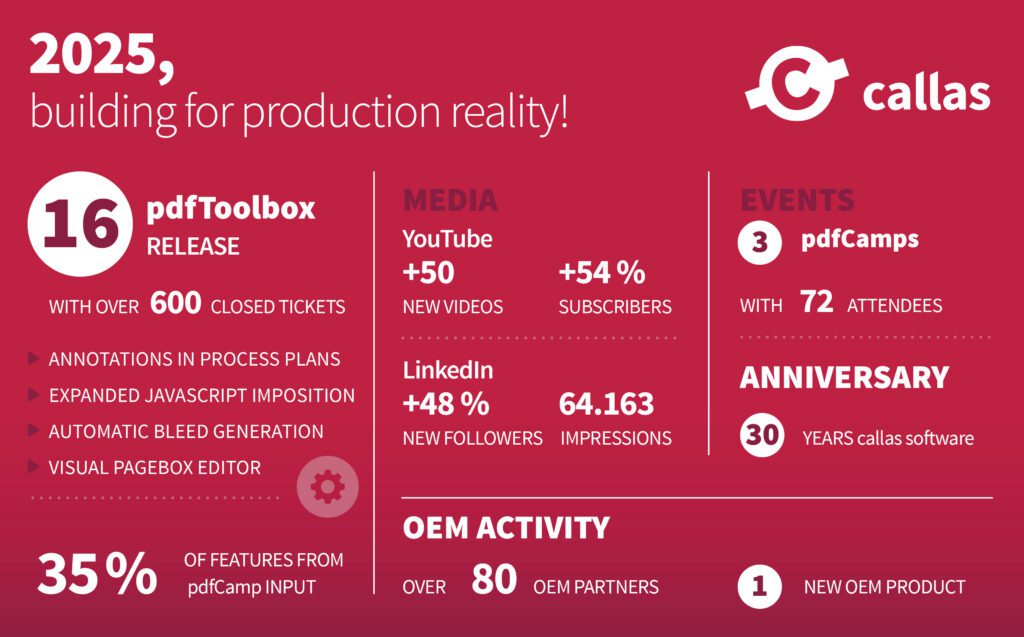
On the product side, pdfToolbox 16 introduced a wide range of improvements driven directly by production reality. These include better documentation of process plans through annotations, more flexible image handling in automated workflows, smarter bleed generation that adapts to individual files, visual editor for correcting page boxes, and expanded JavaScript-based imposition capabilities that remove manual post-processing steps.
But features alone are not enough.
That’s why 2025 also saw a strong focus on how people learn and use pdfToolbox. With the launch of the pdfToolbox Explained video series, we deliberately constrained ourselves to short, focused videos — each under five minutes. Explaining something clearly in that time frame is hard, but that constraint forces clarity. Over the year, 50 videos were published, covering everything from first steps to advanced JavaScript workflows.
We also quietly worked on the callas certification program, starting with two pdfToolbox-focused certifications. The certifications validate practical knowledge of pdfToolbox and are designed so channel partners and end-users can demonstrate they really understand how pdfToolbox functions. This will make it easier for you to find a partner who is properly qualified to help you integrate pdfToolbox so it does what you need.
The first two callas certified pdfExperts have gotten their certification as 2025 gave way to 2026 – perhaps 2026 is the year you also become a pdfExpert?
The message behind all of this is simple: powerful software is only useful if people can actually unlock its potential. Expect more of this focus in 2026.
Thinking with users, not just shipping to them
Another defining element of 2025 was a stronger emphasis on collaboration and openness.
pdfCamp continues to play a central role here. In 2025, we hosted three pdfCamps — two in Berlin and one in London — making it easier for users to participate without long travel times. The format remains intentionally different: no fixed agenda, real production PDFs, real questions, and direct access to the people building the software.
Many of the improvements in pdfToolbox 16 trace directly back to discussions at pdfCamp. In fact, around 35% of new features introduced in 2025 originated from user input — a number we value far more than raw feature counts.
Internally, this shift was supported by changes in how we engage with partners and customers. Distribution moved fully in-house, allowing closer collaboration with resellers and faster feedback loops. Our team grew accordingly, with new roles focused specifically on channel and OEM relationships — including a stronger emphasis on listening, not just delivering.
OEM focus: from components to solutions
OEM business has always been a core part of callas, and in 2025 we strengthened that focus further. callas technology is already used by more than 75 active OEM customers worldwide, and new partners joined throughout the year.
To support this, we launched a dedicated OEM website and introduced pdfToolbox Portal — a configurable framework designed specifically for OEM environments. Rather than forcing a one-size-fits-all solution, the portal allows OEMs to assemble workflows using predefined modules such as manual PDF editing, nesting, or RIP integration, tailored to the needs of specific markets.
This reflects a broader shift: from supplying isolated components to supporting complete, production-ready solutions.
Looking ahead
Looking back, 2025 was a year of change — not change for its own sake, but change driven by the realities of modern production. Print runs are shorter. Margins are tighter. Automation is no longer optional.
Our response to that reality is straightforward: detect problems earlier, fix them reliably, automate where it makes sense, and work closely with the people who depend on these workflows every day.
That is what guided our decisions in 2025 — and it’s what will continue to guide us in 2026.

 pdfToolbox